
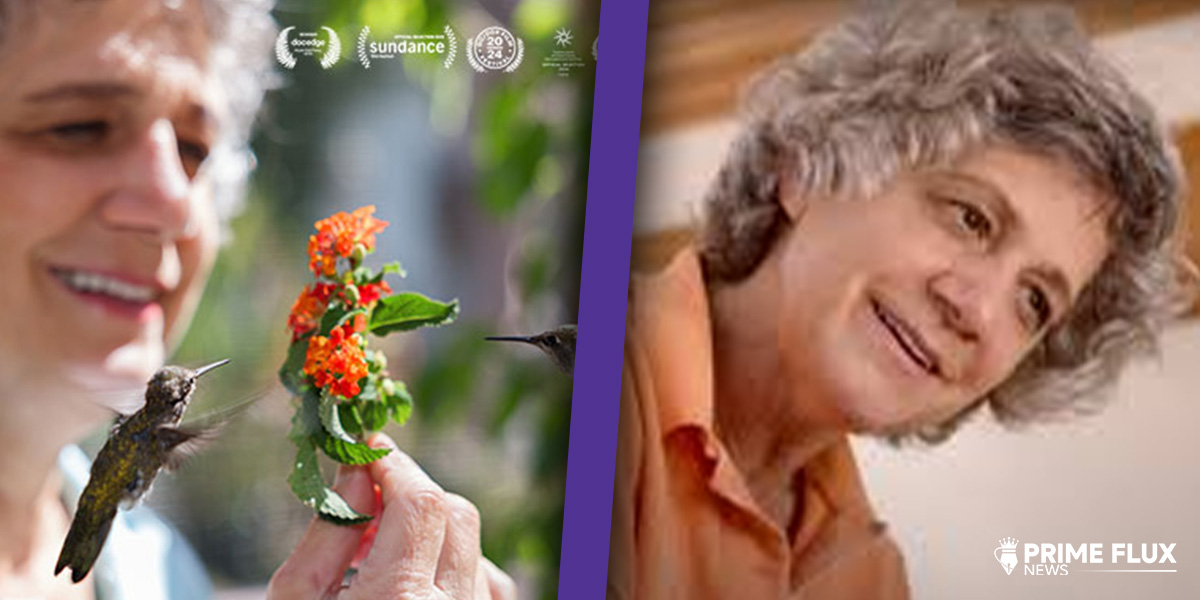
Terry Masear: The Guardian of the World’s Smallest Wonders
Terry Masear is not just a wildlife rehabilitator; she is an artist of empathy and perhaps the world’s leading expert on the survival of the most delicate avian species. Based for decades in Southern California before her recent relocation, Masear has dedicated her life to the preservation of hummingbirds—creatures so fragile they weigh less than a nickel, yet so resilient they can fly thousands of miles during migration. Through her best-selling memoir, Fastest Things on Wings, and the critically acclaimed 2024 documentary Every Little Thing, Masear has brought the “Lilliputian” world of these birds into the global spotlight.
As of January 2026, Terry Masear remains the authoritative voice on hummingbird care. Her journey—from a high-level academic at UCLA to a woman who spends eighteen hours a day feeding orphaned chicks with a syringe—is a narrative of profound transformation. She has successfully managed over 10,000 rescues, turning her domestic space into a high-tech sanctuary where the “stars” are not Hollywood actors, but tiny, iridescent patients with names like Cactus, Jimmy, and Alexa.
The Academic Path to Avian Sanctuary
Terry’s background is rooted in intellectual rigor. Born in southern Wisconsin, she was raised in a “hardscrabble” environment that she describes as fraught with personal trauma and abuse. These early experiences, while painful, instilled in her a “nail-biting” resilience and a deep-seated need to protect the vulnerable.
She eventually moved to Los Angeles, where she carved out a prestigious career in academia. Terry earned her Ph.D. from UCLA and spent twenty years as an instructor of English as a Second Language (ESL) and postgraduate research writing. Her academic precision is evident in her current work; she doesn’t just “save” birds—she researches them, documenting breeding and nesting behaviors that were previously unknown to formal science.
Quick Bio: Terry Masear Overview
| Detail | Information |
| Full Name | Terry Masear |
| Stage/Professional Name | Terry Masear |
| Occupation | Author, Wildlife Rehabilitator, Educator |
| Education | PhD from UCLA (English & Research) |
| Years Active | 2005–Present (Rehabilitation) |
| Famous Patients | Cactus, Jimmy, Mikhail, Alexa, Sugar Baby |
| Major Literary Work | Fastest Things on Wings (2015) |
| Documentary Feature | Every Little Thing (2024/2025) |
| Current Location | Portland, Oregon (Relocated from Los Angeles) |
| Success Rate | ~85% (135 releases per 160 intakes) |
Terry Masear’s age
As of early 2026, terry masear age is in her early 70s. Having retired from her two-decade tenure at UCLA to focus entirely on her “one-woman rescue operation,” she has entered a phase of life she describes as her most “gifted and necessary.” Her age brings a certain “steely realism” to the work. In a field where burnout is high, and the subjects are prone to sudden death, Terry’s maturity allows her to balance the extreme emotional highs of a successful release with the quiet acceptance of burying those she cannot save in her backyard garden.
Read More: Sheree Paolello: Cincinnati’s Emmy-Winning News Anchor
A Professional Legacy Built on Fragility
Masear’s “hummingbird career” began almost by accident in 2003 when her cat brought in an orphaned chick. This led her to a network of rehabilitators and eventually to her role as the operator of the Los Angeles Hummingbird Rescue (LAHR).
By 2026, her impact is measured by:
- The Hotline: Her mobile phone functions as a 24/7 emergency dispatch for bird finders.
- The Documentary: Directed by Sally Aitken, Every Little Thing premiered at Sundance in 2024 to rave reviews, showcasing Terry’s “magic wand” physiotherapy techniques.
- The Volume: LAHR receives roughly 5,000 calls annually, a staggering number for an organization that relies primarily on Terry and a handful of dedicated volunteers.
Terry masear husband Frank
The emotional core of Terry’s story is inextricably linked to her late partner. For 33 years, terry masear husband frank was her constant companion and the “most competent human” she had ever known. Frank supported Terry’s transition from academia to rescue, helping her navigate the logistical nightmare of running an aviary out of their West Hollywood home.
Tidbits About Terry Masear’s husband
Their partnership faced its ultimate test when Terry Masear’s husband was diagnosed with a debilitating form of dementia (Alzheimer’s). For years, Terry balanced the life-saving needs of 160 birds at a time with the round-the-clock care required by Frank.
She often speaks of the profound parallels between the two roles. “Whether human or hummingbird,” she notes in her documentary, “caregiving is an act of fundamental importance.” The patience she learned from Frank—learning to communicate without words and accepting the slow decline of a beloved soul—became the very foundation of her “bird whispering” skills. Frank passed away after 33 years of marriage, leaving Terry to find healing through the tiny, beating hearts she continues to serve.
Terry Masear net worth
Estimating Terry masear net worth is complex because her work is a non-profit endeavor. As of 2026, her net worth is estimated to be approximately $750,000 to $1.2 million. This figure is largely derived from her 20-year career as a UCLA professor and her retirement assets, supplemented by royalties from her best-selling book and film licensing.
It is important to note that Terry frequently funds the rescue work herself. LAHR receives no private institutional funding, and the cost of specialized nectar, high-end cages (which she calls “high-end condos”), and medical equipment often comes directly from her own pocket or modest public donations.
The Portland Transition and Future Goals
In a major life update for 2025-2026, Terry Masear relocated from the Hollywood Hills to Portland, Oregon. This move marks a semi-retirement from the physical labor of hands-on rescue, which she describes as “exhausting and all-consuming.”
However, her work has not stopped. From Portland, she continues to:
- Manage the LAHR Hotline: She remains the first point of contact for thousands of Southern California finders.
- Consultation: She uses video calls to troubleshoot care for rehabilitators across the country.
- Research: She is currently working on a follow-up to Fastest Things on Wings, focusing on the psychological resilience of birds.
Social Media & Digital Presence
Terry maintains a modest but vital digital presence:
- Official Website: losangeleshummingbirdrescue.org
- Facebook (LA Hummingbird Rescue): ~1,250 followers.
- Publicity: Extensive features on Nature (PBS) and CBC Docs, where her videos garner millions of views.
The “Mirror” of Nature: Why It Matters
Terry’s work has been described as a “cinematic balm” and a “mirror to humanity.” She argues that how we treat a helpless, two-gram bird reveals everything about our character. In her view, the hummingbirds are not just animals; they are lessons in resilience, rebellion, and love.
When a bird like Cactus—found impaled by cactus needles—eventually takes flight after months of physiotherapy on Terry’s “magic wand,” it serves as a powerful metaphor for human recovery from trauma.
Innovative Techniques for Fragile Patients
One of the most captivating aspects of Masear’s work is her development of unique rehabilitation tools that bridge the gap between human ingenuity and avian biology. She famously uses what she calls a “magic wand”—a specialized perch that she moves up and down to encourage injured birds to beat their wings without the stress of open flight. This “flight training” is essential for birds like Cactus, who arrived at her clinic caked in debris or impaled by thorns. By mimicking natural movements, Terry helps these “sweet warriors” rebuild the pectoral strength necessary for their high-speed lifestyle. Her techniques are so refined that she can often predict a bird’s probability of success within minutes of its arrival, though she rarely gives up even on those with a 10% chance of survival.
The Global Impact of “Every Little Thing”
The 2024 documentary Every Little Thing, directed by Sally Aitken, transformed Terry from a local hero into an international symbol of compassion. The film uses breathtaking slow-motion macro photography to turn three-gram birds into cinematic protagonists, allowing viewers to see details—like the four color-sensitive eye cones—that are invisible to the naked eye. Audiences worldwide have become emotionally invested in the “tiny tragedies and small victories” of birds like Wasabi and Jimmy. For Masear, the film’s success is not about her own celebrity; it is a vital tool for teaching the “idea of witness”—reminding humans that beauty and complexity exist in the smallest of spaces if we simply choose to pay attention.
A Legacy of Resilience and Healing
Terry Masear’s work serves as a reflection of our own humanity, often highlighting how our treatment of the helpless reveals our collective character. She has noted that hummingbirds found her when she needed them most, providing a sense of healing from her own traumatic past and the grief of losing her husband. Even after her move to Portland, her influence continues through the Los Angeles Hummingbird Rescue collective and her ongoing hotline support. She has effectively bridged the gap between raw, street-level rescue and high-level scientific observation, proving that in the smallest of acts, we might find the greatest amount of grace and a deeper connection to the balance of our ecosystems.
Frequently Asked Questions
Who is Terry Masear?
Terry Masear is a retired UCLA professor and the founder of Los Angeles Hummingbird Rescue. She is a world-renowned expert in rehabilitating orphaned and injured hummingbirds.
Has she really saved 10,000 birds?
Yes. Since 2005, her network has documented over 10,000 successful rehabilitations and releases.
Where can I watch “Every Little Thing”?
The documentary is available on the Kino Film Collection and was featured on CBC Gem in late 2025.
What should I do if I find an injured hummingbird?
Call Terry’s hotline at 310-804-3715. Do not feed it sugar water or try to cage it without professional advice, as their metabolism is extremely delicate.
What happened to terry masear husband frank?
Frank passed away after a long battle with Alzheimer’s disease. Terry cared for him at home for years, a process that deeply informed her empathy for her birds.
Does Terry Masear still live in Hollywood?
No, as of 2025, she has moved to Portland, Oregon, though she still manages the Los Angeles-based rescue operations via her hotline.
How does she fund her work?
She relies on public donations and her own retirement savings. She does not receive government funding for LAHR.
What is the “magic wand” she uses?
It is a custom-made physical therapy perch she developed to help birds with wing injuries regain the muscle strength needed for hovering.
Why does she name the birds?
Terry believes that naming the birds—like Jimmy the “maniac” or Alexa the “star-crossed lover”—helps finders and viewers connect emotionally, ensuring better care and advocacy for the species.